
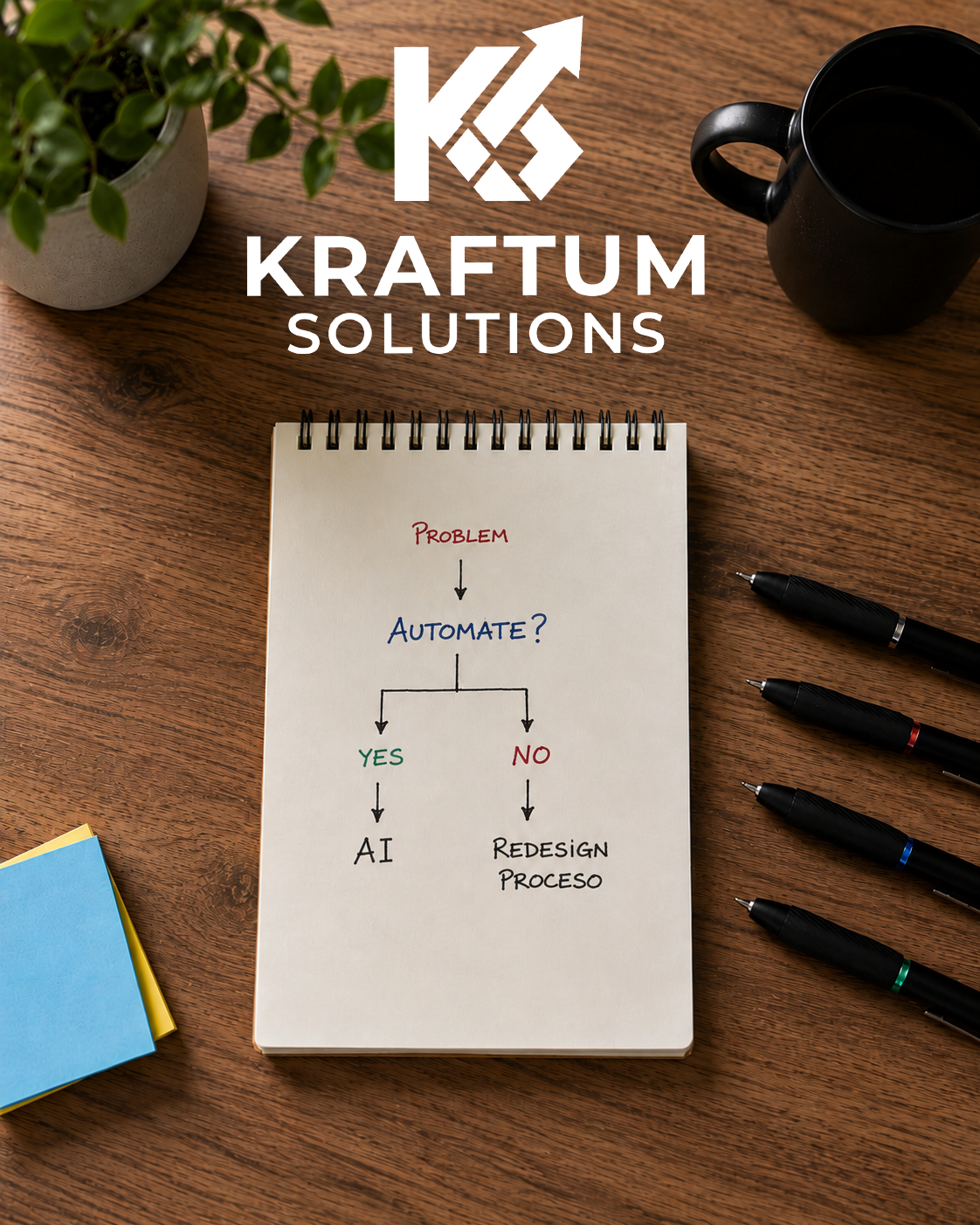
Over the past few years, process automation has become a priority for organizations of all sizes. It’s common to hear that any repetitive task should be automated and that adding more technology will naturally lead to better business outcomes. In many cases, that’s true. Automation can reduce errors, save time, and allow people to focus on work that creates real value.
However, after working on automation, systems integration, and process improvement projects, I’ve reached a conclusion that often goes against conventional thinking: not everything that can be automated should be automated. Automation is not the goal. It is a tool, and like any tool, it only creates value when it solves the right problem.
The Most Common Mistake: Automating the Symptom Instead of the Problem
One of the most common mistakes I see is automating the final step of a process without questioning why that step exists in the first place.
Imagine a company that receives supplier invoices and wants to use OCR or Artificial Intelligence to extract the information automatically and upload it into its ERP. At first glance, it sounds like an excellent solution. It reduces manual data entry, uses modern technology, and saves several hours of repetitive work.
But before designing that automation, it’s worth asking a very simple question: Where did that invoice come from?
In many organizations, the invoice is simply the final result of a process that started with an approved quotation, continued with a purchase order, and ended with billing. In other words, most of the information already existed inside the company from the very beginning.
That leads to another question: Does it really make sense to invest in OCR, Artificial Intelligence, RPA, licenses, infrastructure, and ongoing maintenance just to read information the company already had?
Probably not.
In many situations, it’s far more efficient to capture the data correctly at the beginning of the process and reuse it throughout the workflow. The difference isn’t technological. It’s a matter of process design.
Automating a Bad Process Doesn’t Make It a Good One
One sentence summarizes my perspective on automation better than anything else:
Automating a bad process simply allows mistakes to happen faster.
If a workflow already suffers from inconsistencies, manual workarounds, unnecessary steps, or outdated business rules, adding software won’t solve those issues. It will simply execute the same inefficient process at a higher speed.
Before evaluating technologies or platforms, we should first ask whether the process itself still makes sense. In many cases, the biggest improvements don’t come from building bots or adding integrations. They come from simplifying the workflow or removing unnecessary steps altogether. Technology can accelerate execution, but it cannot fix poor process design.
7 Questions to Ask Before Automating a Process
Before investing time, money, and resources into an automation initiative, it’s worth taking a step back and evaluating it from a broader perspective. These seven questions are not intended to be a universal framework, but they can help distinguish between projects that create real business value and those that become unnecessarily complex and expensive.
1. What Problem Are You Actually Trying to Solve?
Every automation project starts because someone experiences pain. Maybe the process is slow, prone to errors, creates bottlenecks, depends too heavily on a single person, or is simply repetitive.
However, identifying the symptom isn’t the same as finding the root cause. It’s important to understand whether the problem truly originates in the process you’re trying to automate or whether it’s simply the consequence of an earlier issue.
Fixing the root cause often reduces the complexity of the solution—or eliminates the need for automation altogether. Before asking which technology to use, ask why the problem exists in the first place.
2. Who Is Involved in the Process?
The best automation projects aren’t designed exclusively by IT teams or software developers. They are built together with the people who perform the process every day.
Those employees understand the exceptions, undocumented business rules, special cases, and differences between documented procedures and real-world operations. Ignoring that knowledge usually leads to incomplete solutions that people eventually bypass with manual workarounds.
Technology should adapt to the business—not the other way around.
3. How Much Human Judgment Does the Process Require?
Not every process is a good candidate for full automation. Some decisions still require experience, interpretation, and professional judgment.
Think about evaluating a technical claim based on photographs, determining whether an installation meets safety regulations, or reviewing an exception with significant financial or legal implications.
In situations like these, replacing people entirely may not be the right approach. A better solution is often to build tools that organize information, detect inconsistencies, generate alerts, or support experts in making better decisions. Sometimes, successful automation also means knowing when humans should remain part of the process.
4. What Does the Manual Process Cost Today?
Before you can evaluate the return on investment of an automation initiative, you first need to understand the cost of the current process.
That cost goes far beyond labor hours. It also includes mistakes, rework, delays, waiting times between departments, compliance risks, and the opportunity cost of having skilled employees spend valuable time on repetitive administrative tasks instead of work that drives the business forward.
The clearer your understanding of today’s costs, the more objective your decision will be. Without that baseline, it’s easy to justify a project simply because the proposed solution appears more modern or technologically advanced.
5. What Will Automation Actually Cost?
Automation is never free.
Beyond the initial development effort, most solutions require software licenses, cloud infrastructure, API consumption, Artificial Intelligence services, user training, technical support, monitoring, and ongoing maintenance. There is also the cost of updating integrations as systems evolve and business requirements change.
These expenses are often underestimated because they appear after implementation rather than during project planning. Automation doesn’t always eliminate costs—it frequently replaces one type of cost with another. The important question is whether that trade-off genuinely improves business performance.
6. Does the Business Value Justify the Investment?
Saving time is important, but it should never be the only success metric.
A well-designed automation project can also reduce operational risk, improve customer experience, increase data quality, support business growth, and allow employees to focus on higher-value activities.
Business benefits should always be evaluated alongside implementation and maintenance costs.
If the expected value clearly exceeds the investment, you’re probably looking at a strong automation opportunity. If the difference is marginal, the initiative may still be worthwhile—but perhaps not a priority today.
7. Will This Solution Still Make Sense in the Future?
Automation doesn’t end when a project goes live.
Businesses evolve. Processes change. Regulations are updated. Systems are replaced. Data volumes grow.
A solution that works perfectly today can become tomorrow’s technical debt if it was designed too rigidly or depends heavily on a specific technology.
For that reason, sustainability should always be part of the decision. A good automation solution should be easy to understand, maintain, and adapt without requiring a complete redesign every time the business changes.
The Best Solution Isn’t Always the One with the Most Technology
Many organizations associate digital maturity with the number of platforms, automations, AI models, or software tools they use.
I see it differently.
A solution isn’t better because it includes more technology. It’s better because it solves the business problem with the lowest reasonable level of complexity.
If the best answer requires systems integration, workflow automation, or Artificial Intelligence, then building it absolutely makes sense.
But if the same problem can be solved by redesigning the process, standardizing information, or eliminating an unnecessary step altogether, that will often be the smarter investment.
Technology shouldn’t be implemented simply because AI is trending or because robotic process automation demonstrates innovation. Every platform, every integration, every license, and every development hour should answer one fundamental question:
Does this solution genuinely improve the business?
Conclusion
Automation will continue transforming the way organizations operate, and it will remain a key driver of digital transformation for years to come.
However, automation alone is never the objective.
The best solutions are rarely the most sophisticated. They are the ones that solve a real business problem while introducing the least amount of unnecessary complexity.
Before choosing a platform, implementing Artificial Intelligence, or building another integration, take a step back and understand the entire process.
Because at the end of the day, technology shouldn’t exist to impress people.
It should exist to create value.